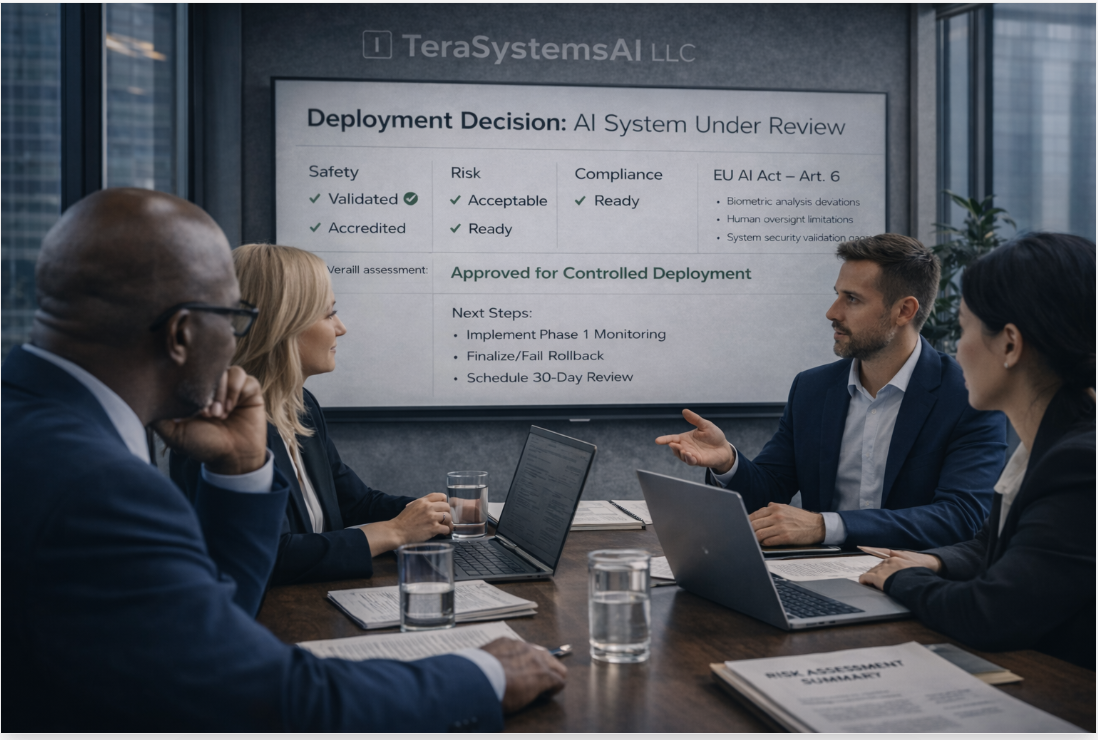

Leadership team reviewing deployment decision materials in a boardroom
Board review context Independent deployment review before regulated launch approval.
Audit team reviewing evidence and compliance documentation during launch assessment
Audit evidence review Documentation, interviews, and control evidence assembled for formal launch assessment.
Launch Decision Audit

You’re 60 days from launch.
Has anyone reviewed whether
this system is safe to deploy?

Most AI system launches have no independent verification. The engineering team believes the system works. Legal has reviewed the contracts. But nobody has produced a documented, independent assessment of whether this specific system is safe to deploy at scale — and what fails if it isn’t.

2–4 weeks
Independent review window with fixed scope and formal decision output.
$15K+
Starting fee for a documented launch recommendation with evidence trail.
3
Explicit verdicts: go, conditional go, or no-go.

Designed for boards, general counsel, compliance leaders, and product teams that need a deployment decision record credible enough for enterprise buyers, regulators, and internal oversight.

What happens when a high-risk
AI system launches without independent review

These aren’t hypothetical. They reflect the patterns that emerge when deployment approval is assumed rather than verified.

Head of Engineering — Regulated HealthTech, Series C
“We ran our own testing. The model’s accuracy was in the 97th percentile of our benchmark suite. We launched. Six weeks later, a subset of users in a specific demographic cohort had error rates 4x higher than the average. It wasn’t in our test set. We’d never checked for it. The board called an emergency session.”
What independent pre-deployment review would have caught: Demographic cohort performance disaggregation as a required pre-launch check under EU AI Act Article 10 for high-risk systems in the health sector.
CCO — Financial Services Firm, EU Operations
“Our enterprise customer sent a due diligence questionnaire two weeks before contract signing. Question 7: ‘Please provide documentation of any pre-deployment independent review conducted on the AI system covered by this contract.’ We had nothing. We almost lost a seven-figure account.”
What this illustrates: Enterprise procurement is increasingly requiring documented independent review as a precondition to contract. “Our internal team reviewed it” is no longer sufficient.
General Counsel — Enterprise SaaS, AI-driven HR Product
“We got the EU AI Act compliance question from three enterprise prospects in the same month. None of us had a clear answer on whether our system was in scope. By the time we figured out it was a high-risk system under Annex III, we’d already been selling it for two quarters.”
What the audit provides: A clear classification opinion, a deployment recommendation, and documentation that demonstrates good-faith compliance effort — which matters even when there’s retroactive scope risk.
Executive and audit team reviewing AI risk summary before deployment approval

This is not a product demo checkpoint. It is a launch decision record.

The deliverable is designed to survive board questions, procurement scrutiny, and regulator review. It documents what was reviewed, what was found, and what conditions must exist before launch.

That distinction matters. High-stakes deployment approval depends on evidence, accountability boundaries, and a written rationale that stands on its own after the meeting ends.

The Launch Decision Audit, precisely defined

Clear scope prevents scope creep. This is what you get — and what this engagement is not.

What it is

Independent technical reviewer examining a specific AI system before production launch
Structured review of failure modes, uncertainty handling, adversarial exposure, and demographic performance
EU AI Act compliance gap analysis scoped to your system’s risk tier
Human oversight mechanism audit: who can intervene, when, and how
Board-readable executive summary with signed deployment recommendation
Technical findings annex for your engineering and legal teams
Remediation roadmap if issues are found (itemized, prioritized, actionable)

What it is not

A rubber stamp — if the system isn’t ready, we say so
A certification (Level I or Level II certification covers your governance program; this covers a specific system)
A software test or penetration test (we review risk methodology, not implementation code)
Ongoing monitoring (that’s the Oversight Desk)
Legal advice (we produce a risk assessment, not a legal opinion)
Unlimited in scope — the engagement covers the documented system; scope changes are quoted separately

Six deliverables. Every engagement.

These are produced regardless of tier. Tier determines depth and coverage of complex systems.

01
Model Risk Assessment
Structured analysis of failure modes under intended use and reasonably foreseeable misuse. Includes uncertainty handling review, confidence output calibration, and adversarial exposure surface.
02
Demographic & Cohort Performance Analysis
Review of performance disaggregation across relevant user subgroups. Flags material disparities before launch. Required under EU AI Act Article 10 for high-risk systems.
03
Human Oversight Mechanism Review
Documents who can intervene in system decisions, under what conditions, with what authority. Verifies Article 14 compliance and that override mechanisms actually function as intended.
04
Regulatory Gap Analysis
Scoped to your system’s EU AI Act risk tier plus any sector-specific regulation (MDR for health, DORA/CRD for finance, NIS2 for infrastructure). Identifies gaps and their compliance priority.
05
Board-Ready Executive Summary
Non-technical summary written for your board and general counsel. Includes the deployment recommendation (Go / Conditional Go / No-Go), the three highest-priority findings, and required preconditions if applicable.
06
Technical Findings Annex
Full technical detail behind each finding: evidence reviewed, methodology applied, confidence level of assessment, and specific remediation steps with priority ranking.

Three scopes. Fixed prices.

Tier is determined by system complexity, number of use cases covered, and regulated sector requirements. All tiers deliver the same six core deliverables.

Standard
Single AI system, one primary use case, limited regulatory sector exposure
$15,000
Fixed scope · 2 weeks delivery
All six core deliverables
Single system scope
One primary use case
EU AI Act tier classification
Board-ready executive summary
Two review sessions included
Enterprise
Multiple AI systems, multiple regulated sectors, or board-level sign-off required for major deployment
$40,000
Fixed scope · 4 weeks delivery
All six core deliverables per system
Multi-system or multi-sector coverage
Full regulatory landscape mapping
Investor/regulator briefing materials
On-site or extended virtual sessions
Live board presentation option
60-day post-delivery advisory access

All engagements require a signed scope agreement and a $3,500 deposit to reserve capacity. Deposit is credited toward the full engagement fee.

The engagement timeline

1
Day 1–2
Scope Confirmation & Materials Request
We confirm the system scope, collect technical documentation (model cards, system design docs, test results, deployment architecture), and schedule stakeholder sessions. You provide read-only access to relevant documentation.
2
Days 3–8
Independent Technical Review
Our reviewer conducts structured analysis: failure mode mapping, uncertainty methodology review, demographic performance disaggregation, human oversight verification, and regulatory gap assessment. No AI systems are used in our review process — all analysis is human.
3
Days 9–12
Stakeholder Sessions
We conduct structured interviews with your engineering lead, product owner, and compliance or legal representative. These sessions surface context not captured in documentation and allow us to probe specific risk scenarios.
4
Days 13–18
Draft Report & Internal Review
We share a draft report for factual accuracy review. You can flag errors of fact (not disagreements with conclusions). We incorporate factual corrections and finalize the report.
5
Day 19–21
Final Delivery & Debrief
Final report delivered. We conduct a debrief session to walk through findings, answer questions, and confirm understanding of the remediation roadmap if applicable. The deployment recommendation (Go / Conditional Go / No-Go) stands independently of the debrief.

Every audit ends with one of three verdicts.

We don’t produce ambiguous language designed to avoid accountability. The deployment recommendation is explicit.

Go
The system meets the reviewed criteria for safe deployment under the documented scope. No material unmitigated risks identified. Deployment may proceed subject to the standard monitoring and oversight obligations documented in the report.
Conditional Go
Specific preconditions must be met before deployment. The report lists each condition explicitly with its justification. Deployment may proceed once each condition is satisfied and documented. A re-confirmation review can be requested.
No-Go
Material unmitigated risk prevents deployment recommendation. The report documents the specific findings, their severity classification, and a prioritized remediation roadmap. A re-review can be scheduled once remediation is complete.

A No-Go verdict with a clear remediation roadmap is more valuable than a rubber stamp. Teams that learn what needs to change before launch avoid the much higher cost of post-launch incidents.

Before you reach out

How much access to our system do you need?+
We work from documentation: system design docs, model cards, test result reports, deployment architecture diagrams, and governance documentation. We do not require source code access, production system access, or training data. If documentation is incomplete, we flag that explicitly in our findings.
Our system isn’t finished yet. Can we still get an audit?+
Yes. Earlier is better. A Launch Decision Audit conducted when the system is 70-80% complete can surface issues while they’re still cheap to fix. We can scope the audit to the finalized components and flag what remaining design decisions could affect the deployment recommendation.
We already have an internal risk assessment. Why do we need an independent one?+
Internal risk assessments are valuable but structurally compromised — the team reviewing their own work has strong incentives to find it acceptable. Regulators, boards, and enterprise buyers are increasingly aware of this. An independent review doesn’t replace your internal work; it validates it (or flags where the internal process missed something).
What if we disagree with the findings?+
You can dispute findings of fact (errors in what we documented) during the draft review period. You cannot revise conclusions by disagreement alone. The independence of the report is its value. We include a formal response mechanism: you may submit a written rebuttal that is appended to the final report as part of the official record.
Is this confidential?+
Yes. All engagements are covered by a mutual NDA signed before scope confirmation. We do not disclose client names, system details, or findings to any third party without your explicit written consent. The audit report is your property.
Our launch date is in 5 weeks. Can you deliver in time?+
Contact us immediately. We maintain capacity for urgency engagements. The Standard tier can often be compressed to 10 business days if documentation is ready at engagement start. There is an urgency surcharge for expedited delivery. Do not delay contacting us based on timeline concerns — those are solvable; a missed launch deadline isn’t.